

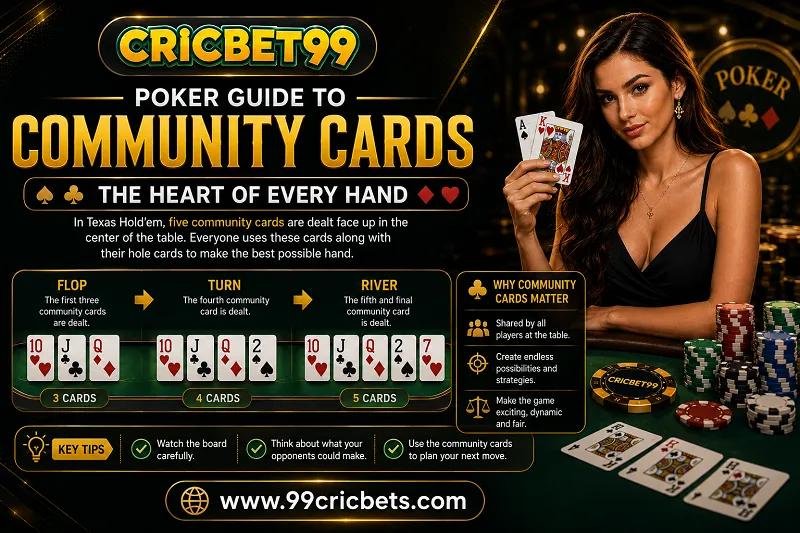
Community cards are one of the most important parts of Texas Hold’em. They are the shared cards placed face-up in the center of the poker table and can be used by every active player to create their strongest possible five-card hand.
For beginners, understanding community cards makes it much easier to follow how a poker hand develops. Instead of focusing only on private hole cards, players can observe the board as new cards are revealed and understand how different combinations may form.
This Cricbet99 Poker Guide to Community Cards explains what community cards are, how they are revealed, how they interact with hole cards, and why learning to read the board is an important part of understanding poker.
What Are Community Cards?
Community cards are cards shared by all players in a Texas Hold’em hand. Unlike hole cards, which are dealt privately to each player, community cards are placed face-up where everyone can see them.
There are five community cards in a standard Texas Hold’em hand. They are revealed in three stages:
Flop: Three community cards Turn: One community card River: One community card
Once all five cards have been revealed, players use the available cards to form their best five-card poker combination.
The community board therefore acts as a common pool of cards that connects every player at the table.
Community Cards vs. Hole Cards
Understanding the difference between community cards and hole cards is essential.
Hole cards are the private cards dealt directly to each player. Other players normally cannot see them.
Community cards are shared cards displayed on the table. Every remaining player can use them when constructing a final hand.
For example, suppose a player receives:
A♠ – 10♠
The flop then appears as:
K♠ – 7♦ – 3♠
The player now has several cards that can contribute to a potential final combination. As the turn and river are revealed, the available possibilities may change.
This relationship between private and shared cards is what makes Texas Hold’em dynamic.
The Flop: First Three Community Cards
The flop is the first group of community cards revealed. Three cards are placed face-up simultaneously.
Imagine the flop is:
Q♣ – 8♥ – 5♣
At this point, every active player can evaluate how these cards interact with their two hole cards.
The flop can create pairs, potential Straights, Flush possibilities, or other combinations. It can also produce a relatively disconnected board where few immediate combinations are available.
Learning to read the flop is one of the first important skills for a new poker player.
The Turn: The Fourth Community Card
After the flop, one additional card is revealed. This card is called the turn.
Suppose the board is:
Q♣ – 8♥ – 5♣
and the turn is:
9♦
The complete board at this point becomes:
Q♣ – 8♥ – 5♣ – 9♦
The turn may introduce new Straight possibilities or improve existing combinations. It can also change which five-card hands are realistically available.
Because only one community card remains after the turn, players should pay attention to how the board is developing.
The River: The Final Community Card
The river is the fifth and final community card.
Suppose the river in the previous example is:
10♠
The complete board becomes:
Q♣ – 8♥ – 5♣ – 9♦ – 10♠
Now the community board is complete.
Players can examine all seven available cards—their two hole cards and five community cards—and identify the strongest five-card combination available to them.
The river can sometimes dramatically change the final hand because it is the last card that can create or complete a combination.
How Community Cards Create Poker Hands
Community cards can contribute to every standard poker hand.
A board containing two cards of the same rank can contribute toward Two Pair or a Full House, depending on the other available cards.
Three matching ranks can help form Three of a Kind.
Four matching ranks across the player's available cards can create Four of a Kind.
Similarly, connected community cards can help form a Straight, while cards sharing a suit can contribute toward a Flush.
The important principle is that the final combination is determined using the best five cards available, not simply by counting how many strong cards appear on the board.
Reading the Board
Board reading means examining the community cards and identifying what combinations they may create.
Consider a board such as:
10♥ – 9♥ – 8♣
This board has connected ranks and two hearts, so several potential combinations may develop as additional cards arrive.
Compare that with:
K♠ – 4♦ – 2♣
This board is much less connected. There are no consecutive ranks and the suits are different.
These differences are often described using the concept of board texture.
Paired Community Cards
A paired board occurs when two community cards have the same rank.
For example:
K♦ – 7♠ – 7♣
The two sevens create a pair on the board.
If another card matching the king or seven appears later, the possible hand structures can change significantly. A paired board can therefore create several different combinations by the river.
Beginners should make a habit of noticing paired cards immediately.
Suited Community Cards
Community cards can also share the same suit.
For example:
A♣ – 9♣ – 4♣
Three clubs are now visible on the board.
This creates a situation where Flush combinations may be possible depending on the hole cards and subsequent community cards.
The more cards of the same suit appear, the more important it becomes to consider how the complete board can interact with players' private cards.
Connected Community Cards
Connected cards have ranks that are close together.
For example:
8 – 9 – 10
creates a highly connected structure because several consecutive ranks are present.
Such a board can support various Straight possibilities.
By contrast, something like:
A – 6 – 2
is much less connected.
Recognizing connected boards helps beginners understand why some community-card combinations create more potential hands than others.
The Best Five-Card Combination
One of the most important rules to remember is that players use their available cards to create the best five-card poker hand.
In Texas Hold’em, a player can have seven cards available by the river: two hole cards and five community cards.
However, the final hand consists of only five cards.
Depending on the cards available, the best five-card hand may use:
Both hole cards
One hole card
Neither hole card
For example, if the five community cards themselves form a player's strongest possible combination, the hole cards may not improve the final hand.
Community Cards and Shared Hands
Sometimes the community board creates a strong combination that several players can use equally.
Suppose the five community cards form the strongest five-card combination available to everyone. If no player can improve that hand using their private cards, multiple players may have an identical final hand.
This is why comparing the complete five-card combination is more important than simply looking at individual hole cards.
Why Community Cards Matter in Digital Poker
Digital poker interfaces usually place community cards prominently in the middle of the table. This makes them easy to monitor throughout the hand.
If you are exploring poker through the Cricbet99 App, learning to recognize the flop, turn, and river can make the table interface much easier to understand.
Users accessing the Cricbet99 APK can also benefit from understanding common poker terms before focusing on more advanced game concepts.
Likewise, Cricbet99 Login users who are becoming familiar with the poker environment can use community-card knowledge to follow each stage of a hand more confidently.
The Cricbet99 Club can also be easier to navigate when fundamental poker terminology is already familiar.
Common Beginner Mistakes
A frequent mistake is assuming that community cards belong to individual players. They do not. They are shared by everyone still participating in the hand.
Another mistake is forgetting the sequence in which the cards appear. The flop has three cards, the turn has one, and the river has one.
Beginners may also focus only on whether their own cards improved without checking what the complete board makes possible.
Finally, it is important not to confuse a potential combination with a completed one. A possible Straight or Flush still needs the appropriate card structure to be present in the final five-card hand.
A Simple Way to Practice
A useful exercise is to take any five community cards and identify all possible combinations.
Start by checking for pairs. Then look for Three of a Kind, Four of a Kind, Straights, and Flushes. After that, combine the board with two imaginary hole cards and determine the best five-card hand.
Repeating this exercise can make hand recognition faster.
When using Cricbet99, the same approach can help beginners understand how the board changes from the flop to the river.
Frequently Asked Questions
How many community cards are there in Texas Hold’em?
There are five community cards: three on the flop, one on the turn, and one on the river.
Can every player use community cards?
Yes. Community cards are shared and can be used by every active player when forming their best five-card hand.
What is the flop?
The flop is the first three community cards revealed together.
What is the turn?
The turn is the fourth community card revealed after the flop.
What is the river?
The river is the fifth and final community card.
Do I have to use my hole cards?
No. Your best five-card hand may use both, one, or none of your hole cards.
Can community cards create a winning hand for multiple players?
Yes. If the board provides the same best five-card combination for multiple players and their hole cards do not improve it, the players can have identical hands.
Why should beginners study community cards?
Community cards determine much of the structure of a Texas Hold’em hand. Understanding them makes it easier to recognize combinations and follow how the game develops.
Final Thoughts
Community cards are at the heart of Texas Hold’em. The flop, turn, and river gradually reveal five shared cards, giving players additional information and creating new possibilities for their final hands.
The key is to look beyond your private cards. Study the board, notice pairs and connected cards, observe suits, and continually reassess the strongest five-card combination available.
Get Cricbet99 ID https://www.99cricbets.com/