

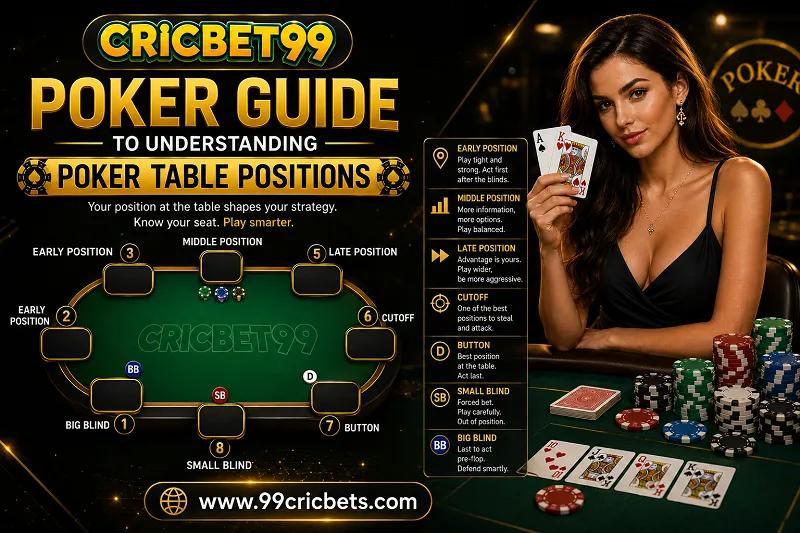
Poker is not only about the cards you receive. Where you sit at the table can also influence how you approach each hand. In Texas Hold’em, table position determines the order in which players act, and that order changes the amount of information available before making a decision.
For beginners, poker positions can seem confusing because different names are used for different seats. Once these positions are understood, however, it becomes much easier to follow the flow of a poker hand.
This Cricbet99 Guide to Understanding Poker Table Positions explains the major positions, why they matter, how positions change around the table, and the terminology beginners may encounter while exploring poker through Cricbet99, Cricbet99 App, Cricbet99 APK, Cricbet99 Login, and Cricbet99 Club.
What Does Poker Table Position Mean?
Poker table position refers to where a player sits relative to the dealer button and, consequently, when that player acts during a round.
The dealer button moves clockwise after each completed hand. Because of this movement, every player eventually occupies different positions.
Position matters because acting later usually provides more information. When other players have already acted, you can observe their choices before making your own decision. Acting earlier means you have less information about what others may do.
This makes position an important part of understanding Texas Hold’em.
The Dealer Button
The dealer button is a small marker that identifies the theoretical dealer position in Texas Hold’em. In a casino or organized game, the actual dealer may be a separate person, but the button still determines the positional order.
After each hand, the button generally moves to the next player.
The two positions immediately following the button are known as the small blind and big blind. These positions have specific responsibilities before the initial cards are dealt.
Understanding the dealer button is therefore the first step toward understanding the rest of the table.
Small Blind Position
The small blind is located immediately to the left of the dealer button.
The player in this position contributes the smaller forced amount before the hand begins. After the cards are dealt, the small blind generally acts relatively early during the post-flop rounds.
The small blind is an important position because the player must make decisions without having the benefit of acting late.
For beginners, remembering its location is simple:
Dealer Button → Small Blind → Big Blind
These three positions form an important reference point for identifying the rest of the table.
Big Blind Position
The big blind sits immediately to the left of the small blind.
The big blind contributes the larger forced amount at the beginning of the hand. In the first round, action proceeds around the table before returning to the blind positions.
After the flop, however, the small blind and big blind are among the earliest players to act.
The big blind is therefore an interesting position because its action order changes between the opening round and later rounds.
Early Position
Players who act relatively early after the blinds are generally described as being in early position.
One commonly used term is Under the Gun (UTG). This position is typically the first player to act before the flop, apart from the blinds' forced contributions.
The phrase “under the gun” reflects the pressure of having to make the first voluntary decision while knowing very little about what the other players might do.
Early-position players therefore have less information compared with players acting later.
Middle Position
The seats between early and late positions are referred to as middle position.
The exact number of middle-position seats depends on the number of players at the table.
A player in middle position has more information than someone acting immediately after the blinds, because some players have already made decisions. At the same time, several players may still be waiting to act.
This makes middle position a useful concept for understanding the gradual flow of information around the table.
Late Position
Late position generally refers to seats closer to the dealer button.
These players act after many of the other players have already made their decisions. As a result, they have more information available before their own action.
The most important late-position term is button, referring to the player sitting directly on the dealer button.
Another commonly used position is the cutoff, which sits immediately to the right of the button.
The Cutoff Position
The cutoff is the seat immediately before the dealer button in the usual order of play.
This position is considered valuable because the player often acts late in a round.
By the time action reaches the cutoff, several players have already made decisions. This provides additional information about how the hand is developing.
For beginners learning poker terminology, remembering the relationship between the cutoff and button is helpful:
Cutoff → Button → Small Blind → Big Blind
The Button Position
The button is widely regarded as one of the most strategically important positions at a poker table.
During post-flop rounds, the button generally acts after the other active players. This means the player has the advantage of observing many decisions before making their own.
The button also serves as the reference point for identifying all other positions.
Because the button moves after every hand, its positional advantage rotates between players rather than belonging permanently to one person.
Why Position Matters
The biggest reason position matters is information.
Imagine two players holding similarly strong cards. One player must act first, while the other can observe several opponents before deciding. The second player has more information available.
This doesn't automatically determine the outcome of a hand, but it affects how decisions can be approached.
Position also helps explain why the same starting cards may be viewed differently depending on where a player is seated.
Position Changes After the Flop
One important concept for beginners is that the action order is not identical during every stage.
Before the flop, the action begins with the player immediately after the big blind.
After the flop, turn, and river, the action generally begins with the first active player to the left of the dealer button.
This means the player who acts first before the flop does not necessarily act first after the flop.
Understanding this difference makes poker tables much easier to follow.
Position and Table Awareness
Good table awareness means knowing both your own position and the positions of the other players.
When looking at a digital poker table, identify the dealer button first. Then locate the small blind and big blind. From there, you can identify early, middle, and late positions.
This simple habit can make a complicated table layout much easier to understand.
If you are exploring poker through the Cricbet99 App, identifying these markers can help you understand why different players act at different times.
Full-Ring and Short-Handed Tables
Position terminology can vary depending on the number of players.
A full-ring table commonly has more players, creating several early and middle positions.
A short-handed table has fewer players, so some positions may disappear or be described differently.
The basic principle remains the same: positions are determined by their relationship to the dealer button and the order of action.
Common Position Terms
Poker players frequently use abbreviated terms to describe table positions.
BTN means Button.
SB means Small Blind.
BB means Big Blind.
UTG means Under the Gun.
CO means Cutoff.
MP generally means Middle Position.
These abbreviations can appear in poker discussions, guides, game interfaces, and educational material.
Users becoming familiar with the Cricbet99 APK may find these abbreviations easier to understand after learning their full meanings.
Common Beginner Mistakes
A common mistake is assuming that position stays the same throughout a session. In reality, the dealer button moves after each hand.
Another mistake is confusing the button with the player who always acts first. The button is actually a reference point, and post-flop action generally proceeds from the first active player to its left.
Beginners may also memorize position names without understanding why they matter. The more useful approach is to connect each position with its location and action order.
Finally, players sometimes concentrate entirely on their own cards and ignore where they are seated. Position is one of the basic pieces of information that should be considered alongside the cards and community board.
Using Position Knowledge on Digital Tables
Digital poker interfaces usually display the dealer button and player seats visually. Once you understand the terminology, these tables become much easier to read.
When using Cricbet99 Login to access the platform, you may encounter different table layouts depending on the game format. Recognizing the button, blinds, and position labels can help you understand the order of play.
The Cricbet99 Club environment can also be easier to navigate when common poker terminology is already familiar.
Position knowledge is not limited to one particular interface. It is a fundamental part of understanding Texas Hold’em wherever the game is played.
Frequently Asked Questions
What is table position in poker?
Table position describes where a player sits relative to the dealer button and when that player acts during each round.
Which position is the button?
The button is the position marked by the dealer button. It moves around the table after each hand.
What are the small blind and big blind?
They are the two positions immediately to the left of the dealer button. They contribute the required blind amounts before the hand begins.
What does UTG mean?
UTG stands for Under the Gun and generally identifies the first player required to make a voluntary decision before the flop.
What is the cutoff?
The cutoff is the position immediately to the right of the dealer button.
Why is late position important?
Late-position players generally have more information because they can observe decisions made by players acting earlier.
Does the button stay with one player?
No. The dealer button rotates around the table after each completed hand.
Does position change during a hand?
The physical positions remain the same, but the order of action changes between the preflop and post-flop stages.
Final Thoughts
Understanding poker table positions is an essential part of learning Texas Hold’em. The dealer button provides the main reference point, while the small blind, big blind, early position, middle position, cutoff, and button describe where players sit and when they act.
The most important lesson for beginners is to recognize that position determines how much information a player has before making a decision. Players acting later can observe more actions, while players acting earlier must make choices with less information.
Get Cricbet99 ID https://www.99cricbets.com/