

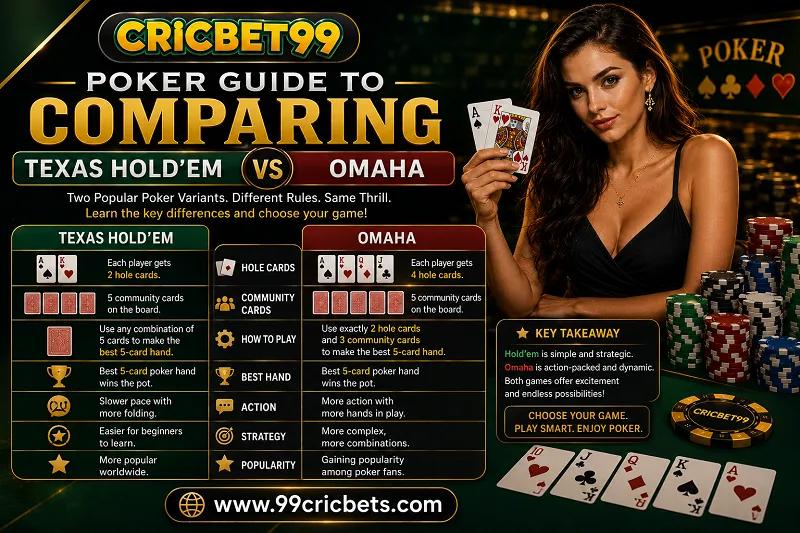
Texas Hold'em and Omaha are two popular poker-style card games that share a familiar structure but offer very different gaming experiences. Both use private cards and community cards, and both follow the same basic poker hand rankings. However, the number of private cards and the rules for creating a final hand make Omaha more complex to analyze than Texas Hold'em.
For players who enjoy learning different card-game formats, understanding these differences is useful. This Cricbet99 Guide to Comparing Texas Hold'em and Omaha explains the main rules, card combinations, gameplay characteristics, learning curves, and terminology associated with both formats.
The goal is not to treat one game as better than the other. Instead, it is to explain how they differ so that players can understand what makes each format unique.
Understanding Texas Hold'em
Texas Hold'em uses two private cards for each player. These cards are dealt face down and remain private during the hand.
Five community cards are then placed face up on the table in stages. The first three are called the flop, followed by the turn and then the river.
The objective is to create the strongest possible five-card poker hand from the available private and community cards. In Hold'em, players have flexibility when constructing this hand. They can use both private cards, one private card, or neither if the community cards already provide the best combination.
This straightforward card structure makes Texas Hold'em an accessible format for beginners. Players can learn the hand rankings and gradually become familiar with concepts such as position, board texture, and hand selection.
Understanding Omaha
Omaha looks similar to Texas Hold'em because it also uses a flop, turn, and river. The major difference is the number of private cards.
In standard Omaha, every player receives four private cards. However, players cannot freely choose any combination of those cards when making their final hand.
The important rule is that exactly two private cards and three community cards must be used to form the final five-card hand.
This rule changes almost every part of hand analysis.
For example, a player cannot use three private cards simply because they appear useful. Similarly, a player cannot use just one private card. The final combination must always contain two cards from the player's hand and three from the board.
The Biggest Difference: Two Cards vs Four Cards
The simplest way to remember the distinction is:
Texas Hold'em gives two private cards. Omaha gives four.
Those additional cards create considerably more possible combinations.
In Hold'em, there is one basic two-card starting combination to evaluate. In Omaha, four private cards create multiple possible pairs and connections.
This means an Omaha player has to look beyond individual card strength. The relationship between all four cards is important.
Four impressive-looking cards do not necessarily make a strong Omaha starting hand. The cards should work together and provide useful combinations with potential community-card patterns.
How Players Build Hands in Texas Hold'em
Hold'em provides considerable flexibility.
Suppose the five community cards create a particular five-card hand. If that is the player's strongest possible combination, they can use the board without needing either private card.
Alternatively, one or both private cards can be combined with community cards to create a stronger hand.
This flexibility is one of the reasons Hold'em is relatively easy to follow. Players can examine their two cards, compare them with the board, and determine which five-card combination is strongest.
As players gain experience, they can move beyond simple hand rankings and begin considering how the board could affect different possible hands.
How Players Build Hands in Omaha
Omaha requires greater attention to card selection.
Imagine that a player receives four private cards. The player must examine possible pairs among those cards and determine which pair can combine with exactly three community cards.
This can be confusing for someone who is used to Hold'em.
For example, seeing several cards of the same suit does not automatically mean that a flush is available. The player still has to satisfy the exactly-two-private-card rule.
This is why new Omaha players should develop the habit of physically identifying the two private cards and three board cards that make their proposed hand.
Why Omaha Creates More Possibilities
The four-card starting hand gives Omaha players many more possible combinations.
This can create possibilities involving pairs, two pairs, sets, straights, flushes, full houses, and drawing combinations.
The increased number of possibilities also means that players need to think more carefully about the board.
A community card that changes the board may improve one player's hand while simultaneously creating new possibilities for another player.
Consequently, Omaha tends to reward detailed card analysis and careful observation.
Starting-Hand Evaluation
Starting hands are approached differently in the two games.
In Texas Hold'em, players can quickly identify familiar combinations such as high pairs, high cards, suited cards, and connected cards.
Omaha requires a more complete assessment.
Instead of asking only, "What are my strongest cards?" players should consider, "How well do all four cards work together?"
Connected ranks can provide multiple straight possibilities. Suitable combinations can provide additional drawing opportunities. Pairs can also interact with other cards in the hand to create different routes toward stronger combinations.
This makes Omaha starting-hand analysis more demanding than Hold'em.
Board Reading in Hold'em
Board reading is an important part of Texas Hold'em.
After the flop appears, players can look at how the three community cards interact with their private cards. The turn and river then provide additional information.
A board can become more coordinated as new cards appear, creating possible straight or flush combinations.
Because Hold'em provides only two private cards per player, there are fewer hidden combinations to consider.
This allows beginners to gradually develop their ability to read the board and understand how community cards influence the overall hand.
Board Reading in Omaha
Omaha requires more detailed board reading because four private cards are involved.
Players need to consider their own possible combinations while also recognizing that opponents have four private cards with which to connect to the same board.
This can make seemingly simple boards more complicated.
The turn may introduce a new drawing possibility, while the river can complete a combination that was not immediately obvious on the flop.
For this reason, Omaha players often need to reassess their hand whenever a new community card appears.
Relative Hand Strength
The poker hand rankings themselves do not change between the two formats. What changes is how frequently different combinations can be created.
Omaha's four-card structure produces more potential connections, meaning players should be careful about assuming that a modest hand is particularly strong.
A single pair that might be useful in a Hold'em situation may have less relative importance in Omaha when several stronger combinations are possible.
The concept of the nuts, meaning the strongest possible hand for a particular board, is especially useful when learning Omaha.
Understanding what the strongest available combinations are can help players read the board more accurately.
Exploring Gaming Concepts With Cricbet99
Players interested in digital gaming environments may want to understand the games they are exploring before focusing on platform navigation.
The Cricbet99 keyword can naturally be included in discussions about online gaming and card-game learning. Someone familiar with Cricbet99 Login may already understand that becoming comfortable with a platform is separate from learning the rules of an individual game.
Likewise, users exploring the Cricbet99 APK or Cricbet99 App can first develop familiarity with basic gaming terminology and formats.
The Cricbet99 Club can also be discussed in the broader context of gaming communities and platform experiences.
Regardless of the platform, however, the rules of Texas Hold'em and Omaha should be learned independently. Platform familiarity does not replace knowledge of the individual game's rules.
Hold'em or Omaha: Which Is More Complex?
The answer depends largely on how a player approaches the game.
Hold'em has fewer private cards and therefore fewer possible combinations to examine. This makes the basic mechanics easier to understand.
Omaha has four private cards, creating many more potential combinations. Players need to evaluate how different pairs of those cards can interact with exactly three community cards.
Therefore, Omaha generally requires more calculation and careful observation.
Players who enjoy straightforward structures may prefer learning Hold'em first, while those who enjoy complex card combinations may find Omaha particularly engaging.
Why Learn Both Formats?
Learning both games can provide a broader understanding of community-card poker.
Hold'em shows how much strategic depth can develop from two private cards. Omaha demonstrates how adding two additional cards can dramatically expand the number of possible combinations.
Comparing the two also prevents players from accidentally applying the rules of one game to the other.
The most important lesson is that similar-looking games can require very different approaches.
Final Thoughts
Texas Hold'em and Omaha share a common foundation, but they are not identical games.
Texas Hold'em gives players two private cards and allows flexible use of private and community cards. Omaha gives players four private cards but requires exactly two private cards and exactly three community cards to create the final five-card hand.
That difference influences starting-hand selection, board reading, drawing possibilities, hand evaluation, and the overall learning curve.
For beginners, Hold'em is often the easier starting point. Omaha can then provide a more complex challenge for players who enjoy analyzing several possible combinations.
Whether someone is learning through Cricbet99, exploring the Cricbet99 App, or simply studying card-game formats, understanding the rules first provides a much stronger foundation.
FAQs
1. What is the main difference between Texas Hold'em and Omaha?
Texas Hold'em gives players two private cards, while Omaha gives four. In Omaha, exactly two private cards and three community cards must be used to create the final five-card hand.
2. Can all four Omaha cards be used?
No. Standard Omaha requires exactly two private cards to be used.
3. Can an Omaha player use only one private card?
No. Exactly two private cards must be used in the final hand.
4. Can players use the board alone in Omaha?
No. Standard Omaha requires two private cards and three community cards.
5. Which game is easier for beginners?
Texas Hold'em is generally easier because there are fewer private cards and greater flexibility when constructing the final hand.
6. Are poker hand rankings different?
No. The standard hand rankings remain the same. The major difference is how the final five-card hand must be constructed.
Get Cricbet99 ID https://www.99cricbets.com/