

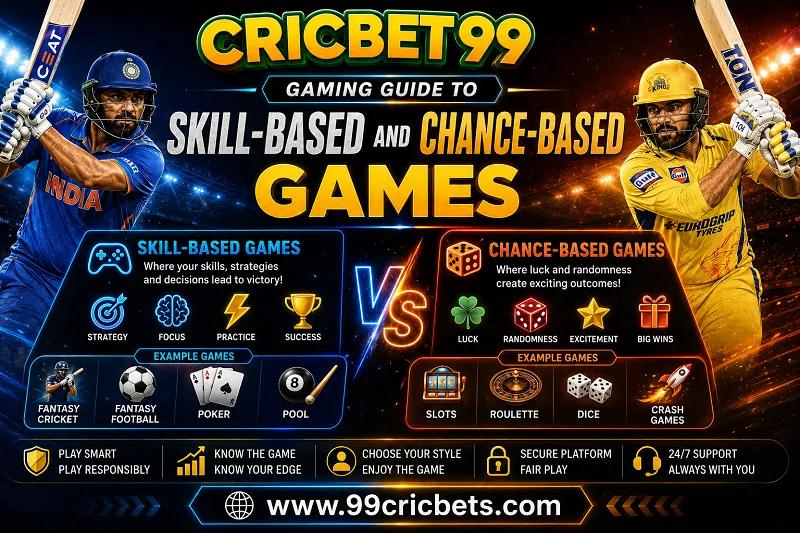
Digital gaming includes a wide range of experiences, from strategy and puzzle challenges to games where random events influence what happens next. One of the easiest ways to understand these different experiences is to look at the role of skill and chance.
Some games depend heavily on player decisions, timing, knowledge, memory, or strategic thinking. Others use random elements to determine important parts of the gameplay. Many modern games combine both approaches, giving players meaningful decisions while also introducing unpredictable events.
Understanding this difference can help players recognize how games are designed and why two titles can feel completely different even when they appear similar on the surface. This Cricbet99 Gaming Guide to Skill-Based and Chance-Based Games explores both categories, explains mixed gameplay systems, and looks at how skill, randomness, strategy, and probability interact.
What Are Skill-Based Games?
Skill-based games are games where the player's abilities have a significant influence on the outcome. These abilities can include logical thinking, reaction speed, memory, planning, pattern recognition, precision, or strategic decision-making.
Chess is a classic example because players make decisions based on the current position of the pieces and their understanding of strategy. Puzzle games can also be strongly skill-oriented because players need to identify patterns and solve problems.
In digital gaming, skill can appear in many forms. A racing game may require accurate steering and timing. A strategy game may require resource management and long-term planning. A puzzle title may test problem-solving abilities.
The defining feature is that the player's choices and abilities have an important effect on gameplay.
What Are Chance-Based Games?
Chance-based games rely more heavily on random or unpredictable events. The player may make choices, but some outcomes are determined by a randomizing system.
Digital games can create randomness through random number generation, randomly selected events, shuffled items, unpredictable enemy behavior, or procedurally generated environments.
In a simple example, a game could randomly select one of several possible events after the player completes an action. The player may control the action itself, but the resulting event is influenced by chance.
Chance therefore introduces uncertainty into gameplay.
The Difference Between Skill and Chance
The easiest way to understand the difference is to consider control.
In a skill-focused game, improving your knowledge or abilities can generally improve how effectively you play. Better decisions, faster reactions, stronger planning, or deeper understanding can influence performance.
In a chance-focused game, some important events are outside the player's direct control. Even if a player understands the rules perfectly, random elements can still produce different outcomes.
However, the distinction is not always absolute. Research into game classification has noted that many games exist somewhere between pure skill and pure chance rather than fitting perfectly into one category.
Pure Skill Is Rare in Modern Gaming
Some games come very close to being entirely skill-driven, but many modern digital titles introduce at least some form of uncertainty.
For example, a competitive strategy game may depend primarily on player decisions while still featuring randomly generated maps. A racing game may depend on driving skill but include changing weather conditions.
This means the presence of randomness does not automatically turn a game into a chance-focused experience.
The more useful question is: How much influence does the player have over the important outcomes?
That question provides a better way to understand the relationship between skill and chance.
How Skill-Based Gameplay Works
Skill-based gameplay usually gives players opportunities to improve through practice and experience.
A beginner might make inefficient decisions because they do not yet understand the game's mechanics. After playing repeatedly, they may learn patterns, develop strategies, improve reaction times, and recognize common situations.
This learning process creates a progression in player ability.
For example, a puzzle game may initially seem difficult because the player has not learned how its mechanics work. With practice, the player becomes faster at identifying solutions.
Similarly, a strategy game can reward players who understand resource management, positioning, timing, and long-term planning.
The improvement comes from learning rather than simply waiting for a different random outcome.
How Chance-Based Gameplay Works
Chance-based gameplay introduces events that players cannot completely control or predict.
Randomness can be used to create variety, surprise, replayability, and uncertainty. Developers may use probability systems to determine which events occur and how frequently different outcomes appear.
For example, a game could randomly generate an enemy type, map layout, item, weather condition, or event.
This can make repeated gameplay feel less predictable because the player cannot simply memorize every event.
Randomness can therefore be a design tool that keeps gameplay dynamic.
Mixed Games: Where Skill and Chance Meet
Many games combine skill and chance.
A player may need to make strategic decisions while responding to unpredictable events. In this type of design, success can depend partly on what the player does and partly on what happens within the game's random system.
Consider a hypothetical strategy game where players build a team and make tactical decisions. The player controls positioning and resource allocation, but the game randomly generates certain events.
A strong player may make better decisions than a beginner, but random events can still change the situation.
This combination creates a more complex gaming environment where skill and uncertainty interact.
Why Developers Use Randomness
Randomness can serve several purposes in game design.
First, it can increase replay value. If every game followed exactly the same sequence, players could memorize the optimal path quickly.
Second, randomness can create surprise. Unexpected events can make gameplay more exciting and prevent every session from feeling identical.
Third, random systems can help create variety. Different maps, challenges, item combinations, or events can provide new situations without requiring developers to create a completely separate game for every session.
Good game design generally aims to ensure that randomness supports the intended experience rather than making player decisions feel meaningless.
Skill Can Influence Decisions Even When Chance Exists
The presence of randomness does not necessarily eliminate skill.
Suppose a game presents a player with three possible actions, and each action has different possible outcomes. The player may not know exactly what will happen, but they can still make an informed decision based on the available information.
This creates an important distinction between predicting an outcome and making a good decision.
A player may not be able to control a random event, but they can sometimes choose the action that best fits the current situation.
That is one reason mixed games can be strategically interesting.
The Role of Probability
Probability is an important part of chance-based game design. It describes how likely different outcomes are within a mathematical system.
For example, a game might have several possible events with different probabilities. A common event may occur more frequently than a rare event.
Understanding probability can help explain why certain events appear frequently while others occur only occasionally.
However, probability should not be confused with certainty. A low-probability event can happen immediately, while a high-probability event can fail to occur during a short sequence.
This is a fundamental part of random systems.
RNG and Chance-Based Games
Many digital games use Random Number Generation, commonly referred to as RNG, to create unpredictable outcomes.
An RNG system produces values that a game can use to select an outcome according to its programmed rules.
For example, an RNG could help determine which item appears, which event is activated, or which random challenge is generated.
RNG and chance are closely related, but they are not identical concepts. RNG is a technical mechanism, while chance describes the uncertainty created by the game's mathematical structure.
Understanding this difference can make technical game information easier to interpret.
Skill, Experience, and Learning Curves
One of the clearest characteristics of skill-based games is the learning curve.
New players may initially struggle with controls, mechanics, timing, or strategy. With repeated practice, they can become more efficient.
A learning curve can include several stages. The first stage involves understanding the rules. The next involves learning effective techniques. Eventually, experienced players may begin identifying advanced strategies and adapting to different situations.
This progression is one of the reasons competitive games can remain engaging for long periods.
A player's performance can change because their understanding of the game improves.
Understanding the Cricbet99 Gaming Environment
Learning gaming terminology can make digital platforms easier to understand.
Users accessing Cricbet99 Login can become familiar with account navigation and available gaming features. New users exploring Cricbet99 Sign Up can gradually learn the terminology associated with different types of digital games.
The Cricbet99 App also provides a mobile-focused environment where understanding basic concepts such as skill, chance, probability, RNG, and game mechanics can be useful.
The key is to approach each game according to its own rules and design rather than assuming that every title works in exactly the same way.
Final Thoughts
Skill-based and chance-based games represent two important approaches to digital game design. Skill-focused games emphasize player decisions, knowledge, timing, strategy, and practice. Chance-focused games use randomness and probability to introduce uncertainty and variation.
However, many modern games combine both. A player may have meaningful control over decisions while random events influence the surrounding circumstances.
Understanding concepts such as probability, RNG, learning curves, and player agency makes it easier to recognize how different games work. It also explains why two titles with similar interfaces can provide completely different experiences.
FAQs
What is a skill-based game?
A skill-based game is one where player decisions, knowledge, timing, or ability have a meaningful influence on performance.
What is a chance-based game?
A chance-based game uses random or unpredictable events as an important part of its gameplay.
Can a game contain both skill and chance?
Yes. Many modern games combine player decisions with random events.
Does practice help in chance-based games?
Practice can help users understand rules and make better decisions, but it cannot necessarily eliminate random elements.
What is RNG?
RNG stands for Random Number Generator. It is a software system used to generate values that can determine random or pseudorandom events.
Are skill-based games always predictable?
Not necessarily. Opponents, environments, and other game elements can still introduce uncertainty.
How can I identify whether a game is skill-based?
Study its rules and determine how strongly player decisions, practice, and ability influence gameplay.
Get Cricbet99 ID https://www.99cricbets.com/